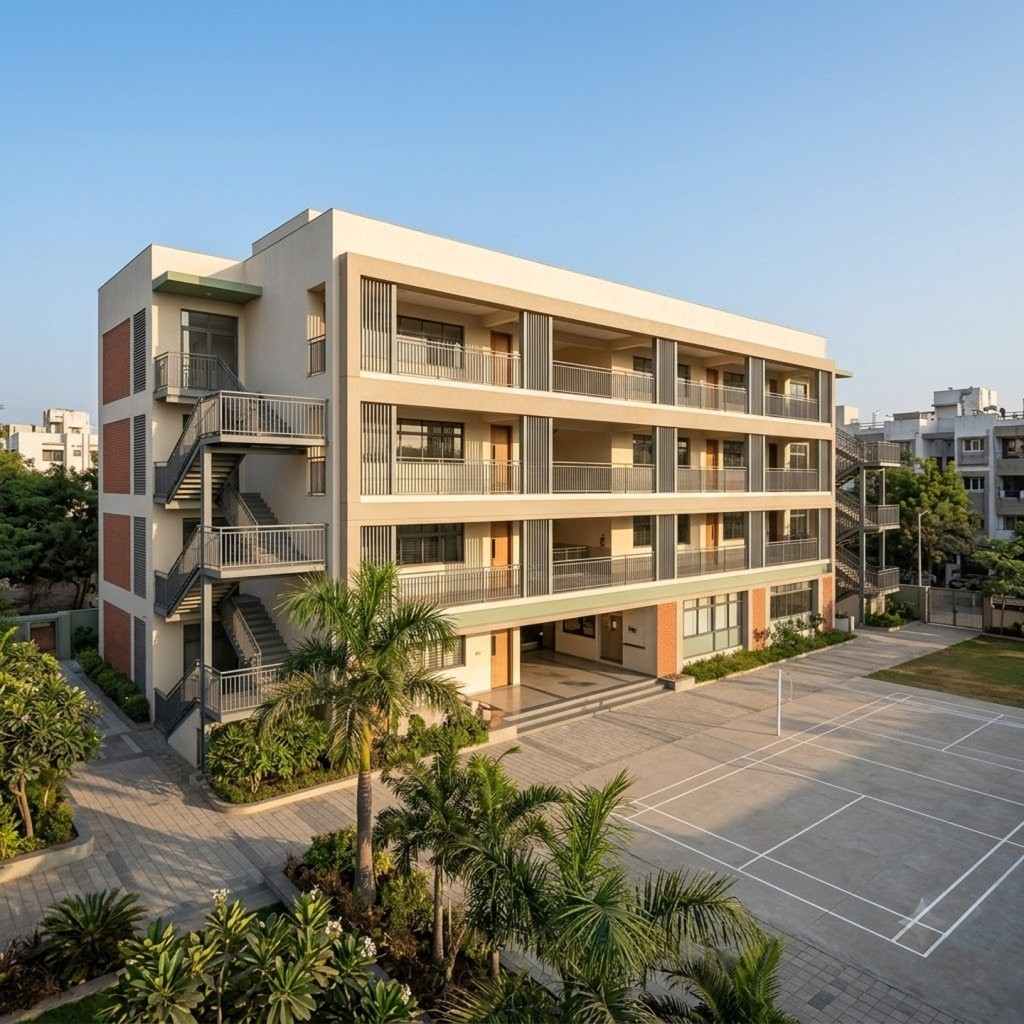
Everything an educational trust needs to know before starting a school construction project in Hyderabad — statutory approvals (GHMC, Fire NOC, Building Safety Certificate, School Recognition), design standards, academic-year deadline pressure, cost bands, and how to evaluate a school construction contractor.
Why school construction is a specialized discipline
A school building looks like a commercial building. It is not. School construction sits under a specific overlay of safety, hygiene, egress, and inspection requirements that ordinary commercial builders often underestimate — and the cost of that underestimation lands squarely on the trust or the school management when the Building Safety Certificate is refused a week before session-open.
The GHMC building code has separate provisions for educational occupancies. The Telangana Fire Services department applies stricter egress standards for schools than for equivalent-area commercial buildings. The Directorate of School Education requires a Building Safety Certificate before the school can enrol students. And the CBSE / State Board recognition process itself hinges on a set of infrastructure norms — classroom areas, toilet ratios, playground area, library, laboratories — that need to be baked into the design from day one, not retrofitted later.
Any construction company you engage for a school project needs to have delivered educational occupancies before, not just commercial buildings that look similar on paper.
The four statutory approvals every school project needs
1. GHMC Building Permission — The core building sanction. For educational occupancies inside GHMC limits, the sanction plan must show classroom areas that meet minimum norms per grade, corridor widths (typically 5.5 metres for internal, 3 metres minimum for staircase-adjacent), two independent staircases for buildings above ground floor, and evacuation paths sized to occupancy load. HMDA approvals apply if the site falls outside GHMC limits.
2. Fire NOC (Class-B Educational Occupancy) — Issued by the Telangana Fire Services department. The audit checks staircase count and width, fire-rated staircase doors, corridor smoke management, sprinkler coverage in corridors and assembly areas, smoke detectors in every classroom, external hydrant layout, and the fire water tank sizing. Educational occupancies are held to stricter standards than commercial — plan the fire package into the structural design, not on top of it.
3. Building Safety Certificate — Issued by a structural engineer empanelled with the Directorate of School Education. This is a hard prerequisite for the school to enrol students under CBSE and State Board recognition. Certificate covers structural integrity, drainage, sanitation, water supply, and safety fixtures. Any structural deviation from sanctioned plan will hold this up.
4. School Recognition / HRC (Human Resource Certificate) — Issued by the Directorate of School Education against a set of infrastructure norms: classroom area per student, playground area, staff room area, library, science laboratories (for higher grades), toilet counts by gender and grade. Recognition is what allows the school to legally enroll students — not the occupancy certificate alone.
Design decisions that come back to bite you if wrong
Corridor width — Sub-5.5-metre corridors will fail Fire NOC audit for educational occupancy. Do not compromise on this at design stage to fit an extra classroom; the classroom you save will cost you the Fire NOC and force a redesign.
Staircase count and placement — Two independent staircases at opposite ends of the building are mandatory for educational occupancies above ground floor. A single central staircase is a Fire NOC rejection regardless of building size.
Classroom ventilation and daylight — CBSE and State Board recognition norms specify minimum window-to-floor ratios and cross-ventilation for classrooms. Poorly ventilated classrooms fail recognition and, more importantly, are miserable for teachers and children.
Toilet counts and layout — Sized per gender and grade to CBSE / State Board ratios. Under-provisioned toilets fail recognition; badly-placed toilets (far from primary sections, adjacent to classrooms without buffering) create discipline problems that persist for years.
Assembly hall clear span — Typically 9 metres or more, column-free. A columned assembly hall dramatically reduces usable seating capacity and hampers school events. Design this correctly at the structural stage; retrofitting later is prohibitively expensive.
Playground and open area — Recognition norms specify minimum playground area per student. Trusts that under-size the plot itself run into recognition issues they cannot design around later. Verify the plot area against expected enrolment before purchase, not after.
The academic-year deadline is real and immovable
The CBSE and State Board academic calendars do not move. A school that misses session-open loses a full year of intake — which is not just a financial hit, it is a reputational one that hurts admissions for years afterward.
This makes school construction one of the most deadline-critical categories in commercial construction. Every design and procurement decision should be weighed against session-open. Every statutory approval should run in parallel with construction, not sequentially after. And the construction contract should include penalty clauses that align to the academic-year deadline, not to a generic handover date.
A good school construction contractor will present you with a Gantt-tracked plan at kick-off that anchors every milestone to session-open, and will insist on running GHMC permission, Fire NOC, Building Safety Certificate, and recognition audit in parallel with civil work — because that parallel sequencing is what makes the deadline achievable.
Cost bands for school construction in Hyderabad
School construction costs vary widely by grade of finishes, structural system, and campus scope. As indicative bands for Hyderabad-area projects: a G+2 RCC school block with basic finishes and standard MEP typically ranges from ₹1,850 to ₹2,300 per sq ft of built-up area. Premium finishes, elevated MEP scope, or additional site development can push this higher.
These bands cover the building envelope, internal fit-out to a normal school standard, standard MEP, standard fire package, and one round of statutory clearances. They do not typically include: boundary wall and gate, external playground development, borewell and water infrastructure, solar plant, or campus-scale landscaping. Ask for these to be listed separately on any quote so you can compare like-for-like.
Get quotes from at least three contractors before signing. Where prices differ, ask specifically what is included and excluded — the difference is almost always in scope, not in efficiency.
What to ask a school construction contractor before signing
How many educational occupancies has your firm delivered in the last three years, and can we visit one? Any answer that dodges this question is disqualifying.
Will you run GHMC permission, Fire NOC, and Building Safety Certificate in parallel with construction, and deliver all three on the day of physical handover? A serious school construction contractor will say yes and put it in the contract.
Who signs off the structural design, and is that engineer empanelled with the Directorate of School Education for Building Safety Certificate issuance? If not, you will need to engage a separate empanelled engineer later.
What is the penalty clause if physical handover slips past session-open? A firm that will not include a session-open-linked penalty in the contract is telling you something about their confidence in their own timeline.
Are named material suppliers attached to the contract? For a school where you and your parents will be judging finishes and safety fixtures for years, this matters.
Kamala Infra delivers school and educational construction projects across Hyderabad under fixed-price contracts, with statutory clearances handled in-house and Gantt-tracked timelines anchored to the academic calendar. If you are planning a school build for the coming academic year, we would welcome an early conversation — the earlier the design freeze, the more compressed the delivery window we can commit to.