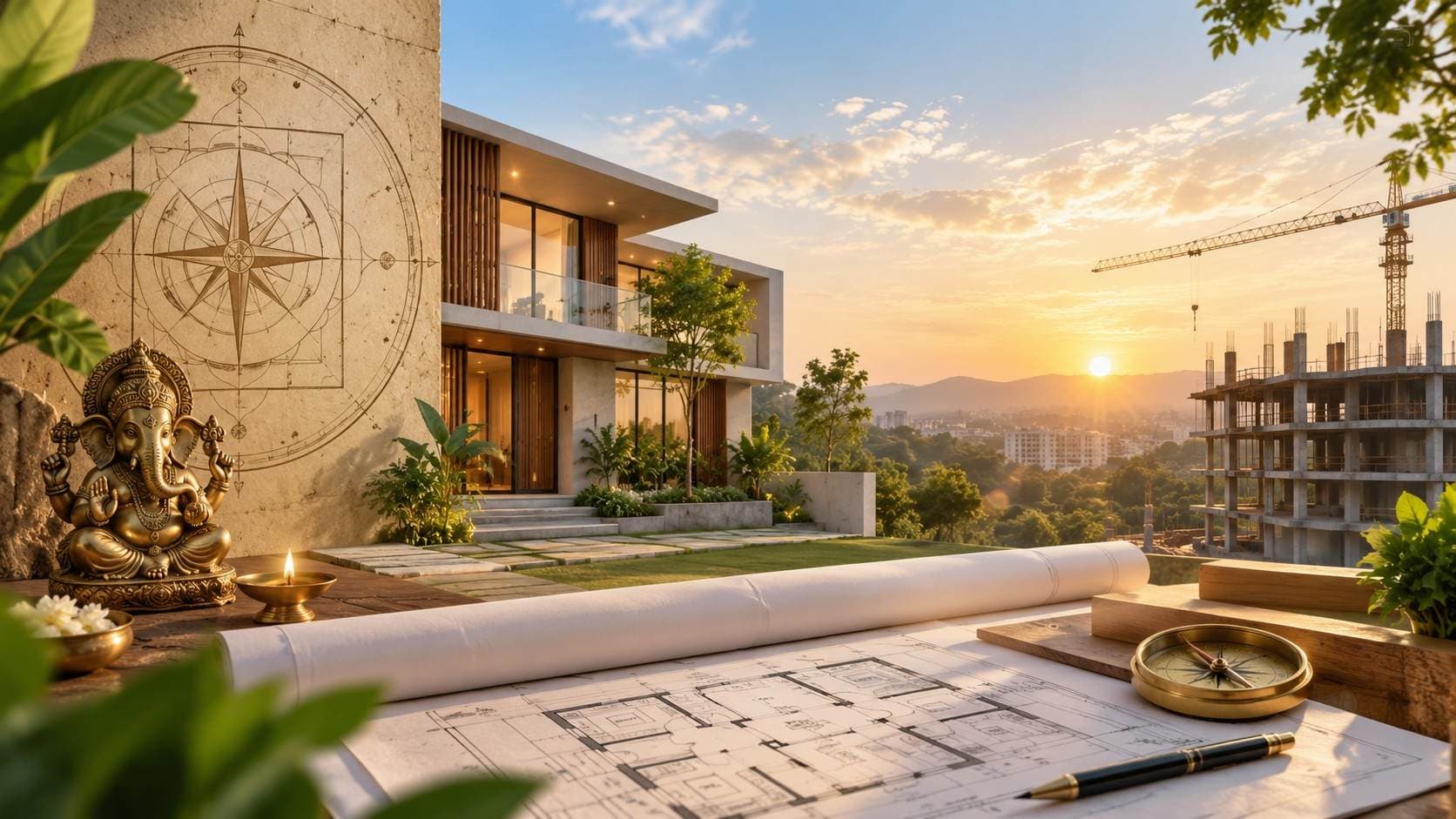
Vastu Shastra is a 5,000-year-old Indian system that codified what modern architects would call “passive design” — sun path, air movement, room adjacency, and the mental effect of oriented space. Strip away the mysticism and it’s remarkably practical: kitchens face the morning sun, bedrooms sit in the cool corners, entrances open where the wind carries in.
Most Hyderabad and Telangana villa buyers ask us for a Vastu-compliant layout. The calculator below gives you a starting analysis for free. When you’re ready for a build, our design team works alongside a certified Vastu consultant — included in Sustainable and Signature tiers — to translate these principles into a plan sanctioned by GHMC / HMDA.
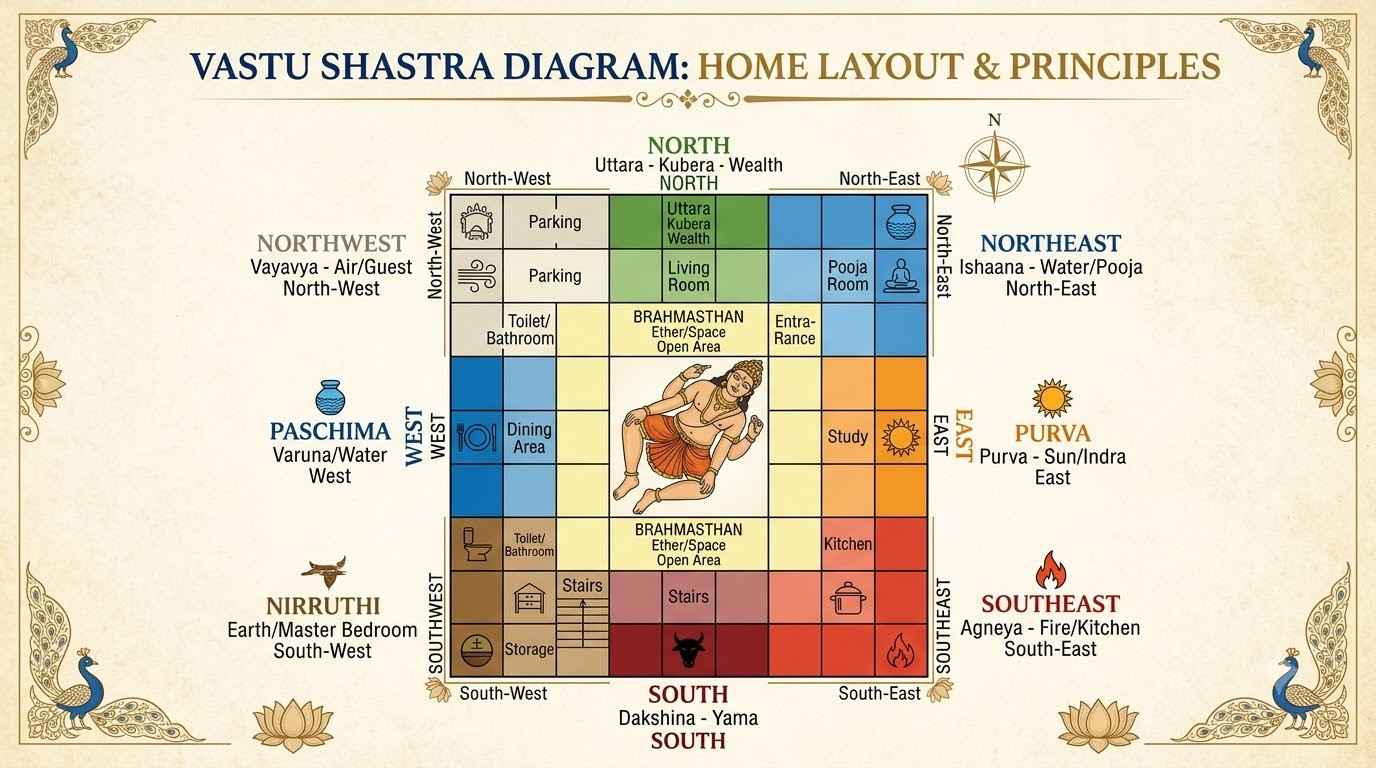
Reference Diagram
The Vastu Purusha Mandala
Nine zones, eight cardinal directions, each ruled by a deity and tied to an element. Use this as a reference while you place your rooms in the calculator below.
Vastu FAQ
What Hyderabad villa buyers ask about Vastu
Is Vastu Shastra mandatory for construction in Hyderabad?
No, Vastu Shastra is not legally mandatory. GHMC and HMDA approvals are based on structural safety, setbacks, and FAR compliance — not Vastu. However, most Hyderabad and Telangana home buyers ask for Vastu-compliant design because it reflects a long cultural tradition and often influences resale value. Kamala Infra can build either strictly Vastu-compliant or Vastu-informed homes depending on what you prefer.
Can Vastu defects be corrected in an existing home?
Yes, most Vastu defects (Dosha) can be corrected through remedial measures — repositioning of furniture, mirror placements, strategic use of colours, plants, and specific elements. Major structural corrections may require renovation. During our design phase, we work to eliminate defects from day one, which is far cheaper and more effective than post-build remedies.
What is the best facing direction for a home?
In Vastu, East and North-facing homes are traditionally considered the most auspicious. Northeast (Ishanya) is the most sacred direction. However, all directions can be worked with — well-designed Southwest or South-facing homes with proper Vastu principles applied can be equally prosperous. The facing direction matters less than internal room placement, entrance position, and overall energy flow.
Are all facing directions equal in Vastu?
No, different facing directions have different characteristics. North (Kubera) attracts wealth; East (Indra) brings health and honour; Northeast (Ishana) offers spiritual growth. Southwest is considered challenging as a facing direction but excellent for master bedroom placement. Each direction has its ruler, element, and recommended use — the calculator above walks you through your specific facing.
How is Vastu different from Feng Shui?
Both are ancient systems of architectural harmony but from different traditions. Vastu Shastra originated in India ~5,000 years ago and is rooted in Vedic philosophy — it emphasises five elements (earth, water, fire, air, space), cardinal directions, and cosmic energy flow. Feng Shui is Chinese, focuses on energy (Chi) flow using the Bagua map and yin-yang balance. Both aim for harmony but their techniques and cultural context differ significantly.
Does Kamala Infra follow Vastu strictly in every build?
We offer three levels: strict Vastu compliance (main entrance, kitchen, bedroom, pooja room all Vastu-perfect), Vastu-informed design (major placements follow Vastu but not every room), or modern architecture without Vastu emphasis. Your choice — we design to it. Our Sustainable and Signature tiers include Vastu consultation as part of the design phase.
What are the most common Vastu violations to avoid?
The five most common violations we see in Hyderabad builds are: (1) toilets or septic tanks in the Northeast, (2) kitchen in the Northeast (fire in water zone), (3) master bedroom in the Northeast (should be in Southwest), (4) main entrance in the Southwest, and (5) staircase in the exact centre (Brahmasthan) of the home. All of these can be avoided during the design phase.
Can Vastu principles work with modern architecture?
Absolutely. Modern architectural styles — open-plan layouts, glass facades, split-level homes — can all be designed to respect Vastu principles. It requires more thoughtful design, not compromises on modernity. The core principles (natural light, ventilation, positive energy zones, elemental balance) actually align well with contemporary sustainable design.
Expert Consultation
Ready for a Vastu-compliant home design?
Every Kamala Infra design in the Sustainable and Signature tiers includes Vastu consultation with a certified expert — woven into the design phase, not bolted on afterwards.
Upload your floor plan and get an instant Vastu report. Every room is identified, scored against traditional Vastu rules, and given ideal placement recommendations — no manual tagging needed.
North at top · South at bottom
Upload your floor plan
We read your plan, identify every room, and detect the North direction from the compass mark. Your Vastu score appears in seconds — no manual tagging needed.
PNG / JPG / WEBP · up to 8 MB · takes 3–6 seconds
Or Check Manually
Prefer to enter room details manually?
Use the 3×3 Vastu Purusha Mandala grid below to place each room in its zone. Same scoring engine — rooms filled in by the detector above will show here too.
North-West
Vayavya
Ruler: Vayu
North
Uttara
Ruler: Kubera
North-East
Ishanya
Ruler: Ishana
West
Pashchima
Ruler: Varuna
Centre (Brahmasthan)
Brahma
Ruler: Brahma
East
Purva
Ruler: Indra
South-West
Nairritya
Ruler: Pitru
South
Dakshina
Ruler: Yama
South-East
Agneya
Ruler: Agni
0 of 9 zones assigned
Reference Guide
Ideal Vastu placement for every room
Kitchen
Ideal: South-East
Acceptable: North-West
Avoid: North-East, North, Centre (Brahmasthan), South-West
Southeast is ruled by Agni (fire deity) — the ideal zone for the cooking hearth.
Master Bedroom
Ideal: South-West
Acceptable: South, West
Avoid: North-East, South-East, Centre (Brahmasthan)
Southwest represents earth element — grounds the head of household and brings financial and emotional stability.
Bedroom (Children / Guest)
Ideal: West, North-West
Acceptable: South
Avoid: South-West, South-East
West / Northwest support learning, growth and adaptability — good for children and guests.
Living Room / Hall
Ideal: North, East, North-East
Acceptable: North-West
Avoid: South-West
The living room welcomes guests and family energy — best placed in auspicious N/E/NE zones.
Drawing / Formal Room
Ideal: North, East, North-East
Acceptable: West, North-West
Avoid: South-West
Drawing rooms benefit from the same welcoming energy as a living hall.
Pooja / Prayer Room
Ideal: North-East
Acceptable: East, North
Avoid: South, South-West, West, South-East
Northeast is the most sacred zone (Ishana). Face east or north while praying.
Study Room
Ideal: East, North-East
Acceptable: North, West
Avoid: South-West
East (Indra's direction) enhances concentration and success in learning.
Bathroom
Ideal: North-West, West
Acceptable: South
Avoid: North-East, Centre (Brahmasthan), South-West, South-East
Bathrooms fit the NW / W wind and water zones. NE is forbidden — waste in the sacred zone disturbs prosperity.
Toilet
Ideal: North-West, West
Acceptable: South
Avoid: North-East, North, East, Centre (Brahmasthan), South-West
Toilets must be far from sacred and auspicious zones. NE placement is one of the worst Vastu doshas.
Store Room
Ideal: South-West, South
Acceptable: West, North-West
Avoid: North-East, Centre (Brahmasthan)
Heavy storage grounds the SW earth zone — reinforces stability.
Staircase
Ideal: South, South-West, West
Acceptable: South-East
Avoid: North-East, North, Centre (Brahmasthan)
Staircase in NE blocks positive energy flow; centre placement disturbs the Brahmasthan.
Dining Area
Ideal: West, East
Acceptable: North, South
Avoid: Centre (Brahmasthan), South-West
West is traditionally ideal for the dining space; facing East or North while eating aids digestion and family harmony.
Home Office / Work Room
Ideal: North, East, North-East
Acceptable: West, North-West
Avoid: South-West, South
North (Kubera — wealth) and East (Indra — clarity) suit work. Sit facing East or North while at the desk.
Utility / Wash Area
Ideal: North-West, South-East
Acceptable: West
Avoid: North-East, Centre (Brahmasthan), South-West
NW (wind zone) supports drying; SE (fire zone) suits appliances such as the washing machine.
Servant / Guest Quarters
Ideal: North-West
Acceptable: South-East, South
Avoid: North-East, South-West, Centre (Brahmasthan)
NW is the traditional service zone (Vayu). SW is reserved for the head of household.
Balcony / Verandah
Ideal: East, North, North-East
Acceptable: North-West
Avoid: South-West, South
Balconies in NE / N / E receive morning sunlight and welcome positive energy. SW balconies drain earth stability.
Garage / Car Parking
Ideal: North-West, South-East
Acceptable: North, West
Avoid: North-East, Centre (Brahmasthan), South-West
NW (wind) suits vehicles' outward movement; SE (fire) also works. NE parking blocks the sacred zone.
Entrance / Main Door
Ideal: East, North, North-East
Acceptable: West
Avoid: South-West, South
Main door in E / N / NE invites prosperity (Indra, Kubera, Ishana). South-facing doors need remedies.
Placements follow the traditional Vastu Purusha Mandala. Every plot is different — for a serious build, a certified Vastu consultant should verify against site-specific slope, surroundings and the owner’s birth chart.